
Wholesale Seat Covers: A Complete Buying Guide for Distributors and Retailers
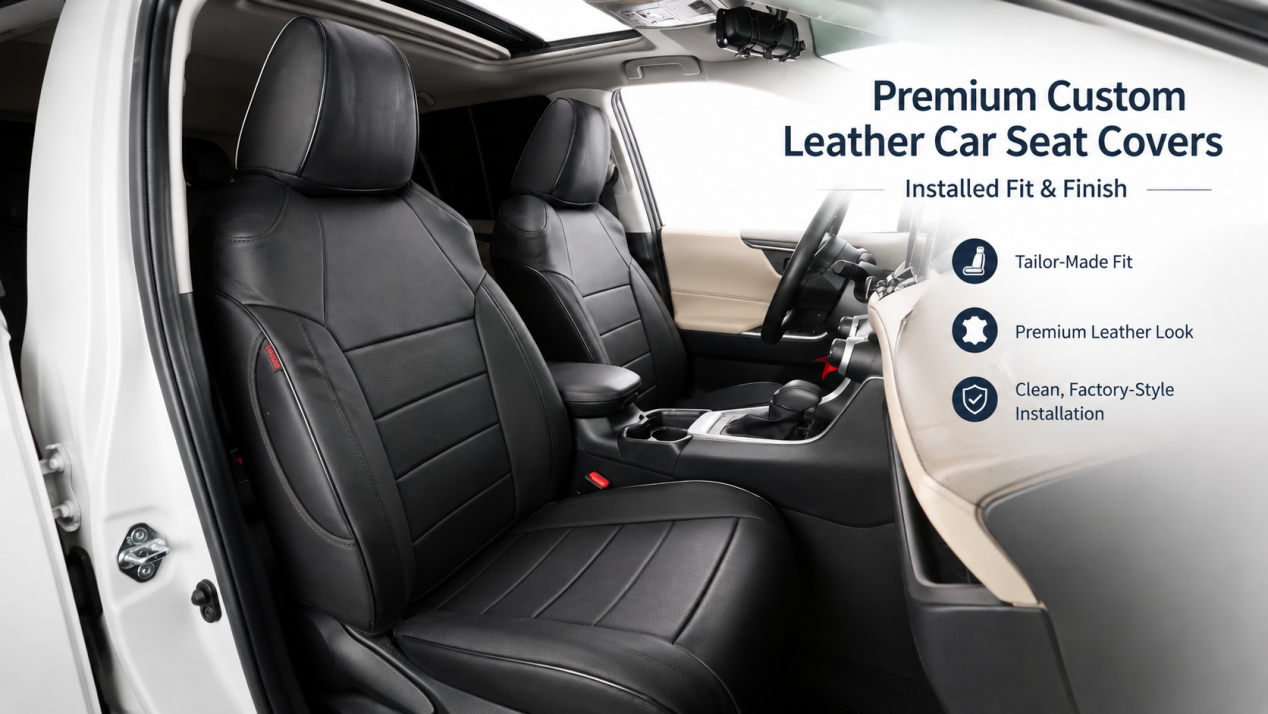
Wholesale Seat Covers: A Complete Buying Guide for Distributors and Retailers
Buying wholesale seat covers is not simply about finding the lowest factory price.
For distributors, retailers, auto customization shops, e-commerce sellers, rental fleets, and private-label brands, fitment, material quality, SKU accuracy, production consistency, and supplier reliability can have just as much impact on profitability as the unit cost.
This becomes even more important with vehicle-specific products. A small pattern error can turn into repeated returns, installation complaints, negative reviews, and inventory problems across an entire SKU.
This guide explains how to compare seat cover types, evaluate manufacturers, test samples, control quality, calculate total cost, and build a wholesale sourcing program that can scale.
Quick Takeaway: If you plan to compete in the mid-range or premium market, evaluate fitment and manufacturing consistency before comparing price. A cheaper seat cover is not necessarily a lower-cost product once returns, installation problems, and replacement costs are included.
Wholesale seat covers are purchased in bulk for resale, professional installation, fleet use, private-label programs, or direct-to-consumer fulfillment.
For B2B buyers, the physical product is only one part of the purchasing decision.
You also need to know whether the supplier can reproduce the same fit, material, stitching, color, packaging, and vehicle application across future orders.
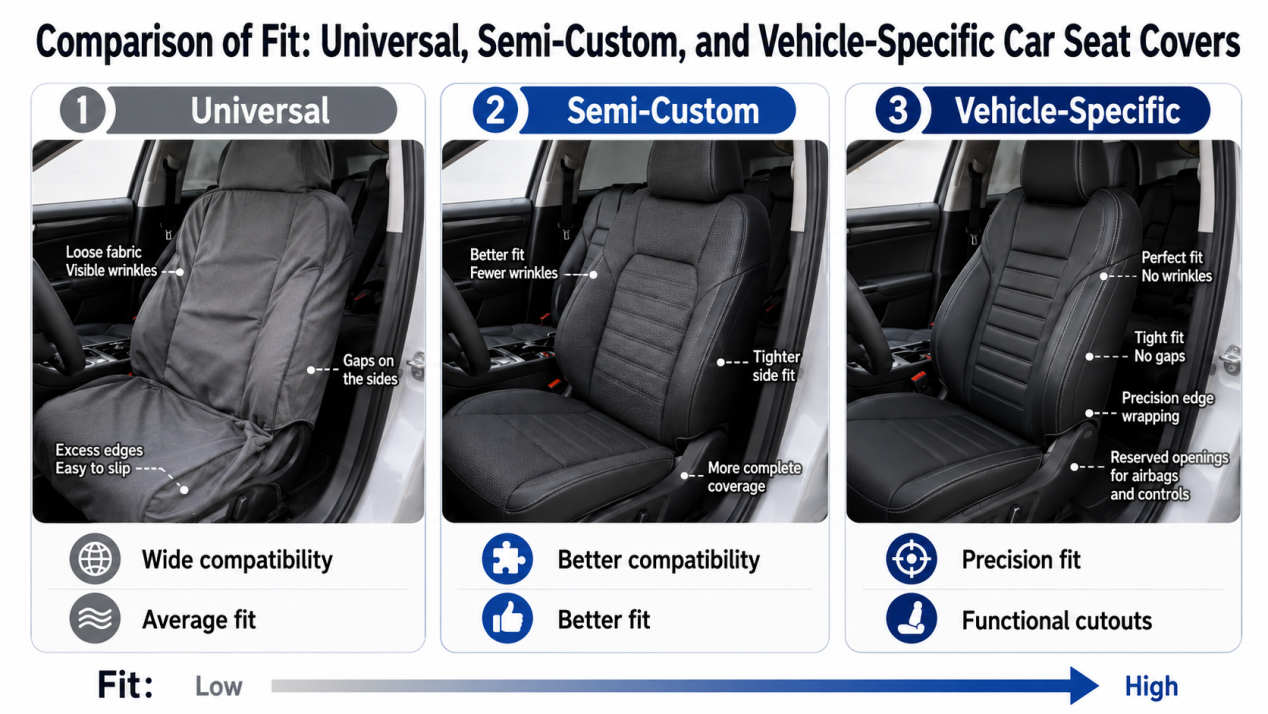
The three main categories are universal-fit, semi-custom, and vehicle-specific custom-fit seat covers.
Universal Seat Covers
Universal covers use a general pattern designed to work across many vehicles.
They are easier to stock because a single SKU may be compatible with multiple models. This makes them suitable for price-sensitive markets, promotional programs, and retailers that want to keep inventory complexity low.
The trade-off is fit.
Because the pattern must accommodate many seat shapes, universal covers may leave wrinkles, loose edges, exposed areas, or less accurate seam positioning.
Semi-custom covers sit between universal and fully custom products.
They may be developed around a particular seat type, vehicle category, or shared seat platform instead of one exact vehicle configuration.
This can provide a cleaner appearance while keeping the number of SKUs more manageable.
For businesses that want better fit without carrying hundreds of model-specific products, semi-custom covers can be a practical middle ground.
Vehicle-specific covers are developed for a particular make, model, model year, and seat configuration.
A well-developed pattern can account for:
- Seat contours
- Headrests
- Armrests
- Rear-seat splits
- Seat-control areas
- Seatbelt access
- Folding functions
- Other vehicle-specific details
This requires more pattern development and more careful SKU management.
In return, distributors and retailers can offer a product with a more tailored appearance, better installation stability, and stronger premium positioning.
|
Buying Factor |
Universal Fit |
Semi-Custom Fit |
Vehicle-Specific Custom Fit |
|
Vehicle Coverage |
Broad; one SKU may fit many vehicles |
Selected seat types or vehicle groups |
Specific makes, models, years, and seat configurations |
|
Fitment Accuracy |
Basic |
Moderate |
High |
|
Installed Appearance |
Functional; wrinkles may remain |
Cleaner than universal |
Tailored, OEM-like appearance |
|
SKU Complexity |
Low |
Medium |
High |
|
Inventory Requirement |
Easy to manage |
Moderate |
Requires model-level planning |
|
Product Development |
Minimal |
Moderate |
Pattern development and fitment validation required |
|
Typical Price Position |
Entry-level |
Mid-range |
Mid-range to premium |
|
Private Label Potential |
Moderate |
Good |
Strong |
|
Fitment-Related Return Risk |
Higher if compatibility is too broad |
Moderate |
Lower when patterns and vehicle data are accurate |
|
Best For |
Discount retailers, promotions |
Mainstream retailers |
Premium retailers, distributors, customization shops, private-label brands |
Different B2B buyers have different priorities.
Wholesalers and distributors usually care about stable pricing, broad vehicle coverage, repeat production, and inventory efficiency.
Auto customization shops care more about fitment, installation time, material feel, stitching, and the final appearance inside the vehicle.
Retailers and e-commerce sellers need accurate compatibility information, sellable packaging, clear product data, and low return rates.
Rental companies and fleets tend to prioritize protection, durability, cleaning, and lifecycle cost.
Dropshipping sellers depend heavily on SKU and fulfillment accuracy because the supplier may ship directly to the final customer.
Your business model should therefore determine the product strategy before you start comparing quotations.
Fitment affects appearance, installation, customer satisfaction, and return rates.
A seat cover can use attractive material and clean stitching, but customers will still notice if it wrinkles badly, shifts during use, leaves unwanted gaps, or does not align correctly with the seat.
For premium products, fitment is one of the clearest differences between a commodity accessory and a higher-value interior upgrade.
Universal covers offer broad compatibility and fewer SKUs.
Vehicle-specific products give the manufacturer much greater control over seat contours, seam locations, coverage, attachment points, and functional openings.
If customers mainly want inexpensive protection, universal fit may be sufficient.
If they are paying more for appearance, professional installation, or an OEM-like result, custom fit usually makes more sense.
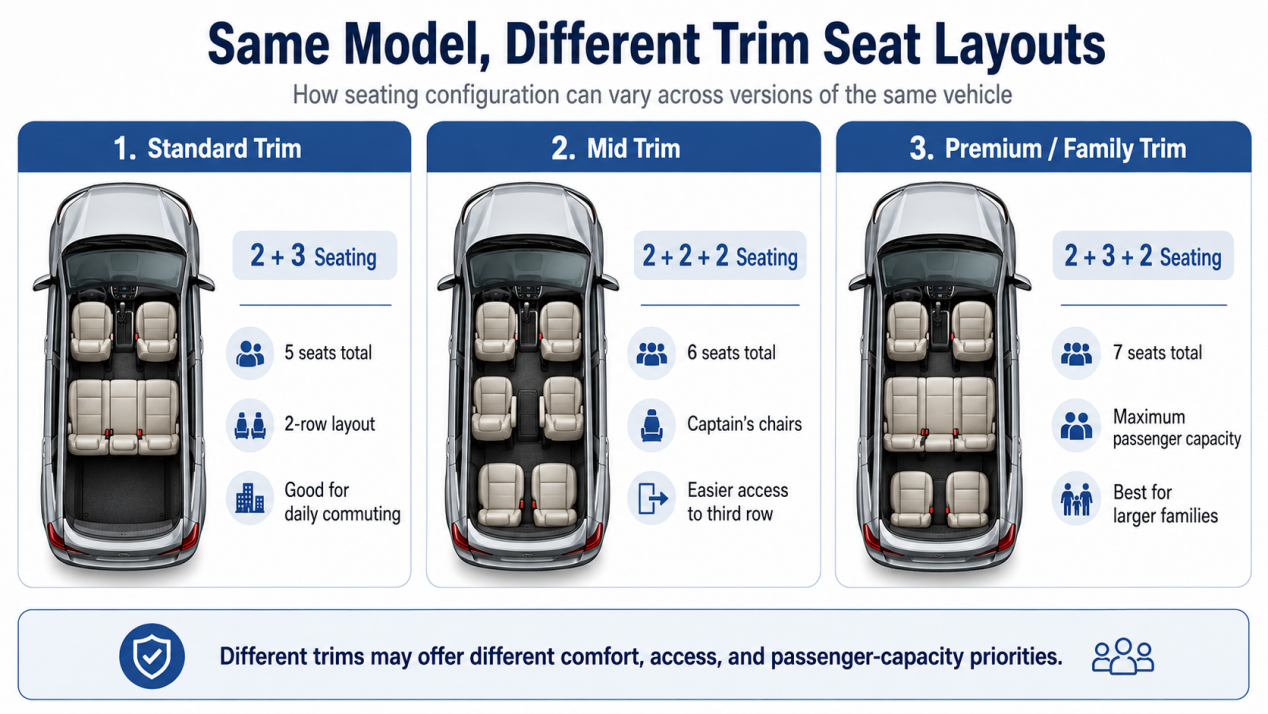
Do not assume every vehicle with the same model name uses identical seats.
Seat configuration can change by model year, trim, body style, market, and optional equipment.
A base trim may have manual controls while another trim uses power adjustment or different side bolsters. Rear-seat split ratios, headrests, and armrests can also change.
When requesting a vehicle-specific product, provide accurate information such as the make, model, model year, trim, body style, front- and rear-seat configuration, rear-seat split, headrest design, armrests, seat controls, and clear photographs.
For companies managing large North American product catalogs, standardized vehicle fitment data such as ACES can also help organize and exchange application data. Auto Care describes ACES as an aftermarket industry standard for communicating product fitment data.
Modern seats include many functions that a seat cover needs to work around.
These can include:
- Removable or integrated headrests
- Center armrests
- Seatbelt buckles
- Power controls
- Manual levers
- Rear folding mechanisms
- 60/40 or 40/20/40 split seats
- Heated or ventilated seating
- Seat-mounted safety components
If these details are ignored during development, the cover may technically install but still create a poor customer experience.
Precise fit creates visible value.
Cleaner corners, better seam alignment, controlled tension, and closer coverage can make the product look more integrated with the original vehicle interior.
For an auto customization shop, better fit can also shorten adjustment time.
For an e-commerce seller, it can reduce the difference between product-listing photographs and what customers actually receive.
Fitment is therefore not simply a cosmetic detail. It can become part of the commercial value of the product.
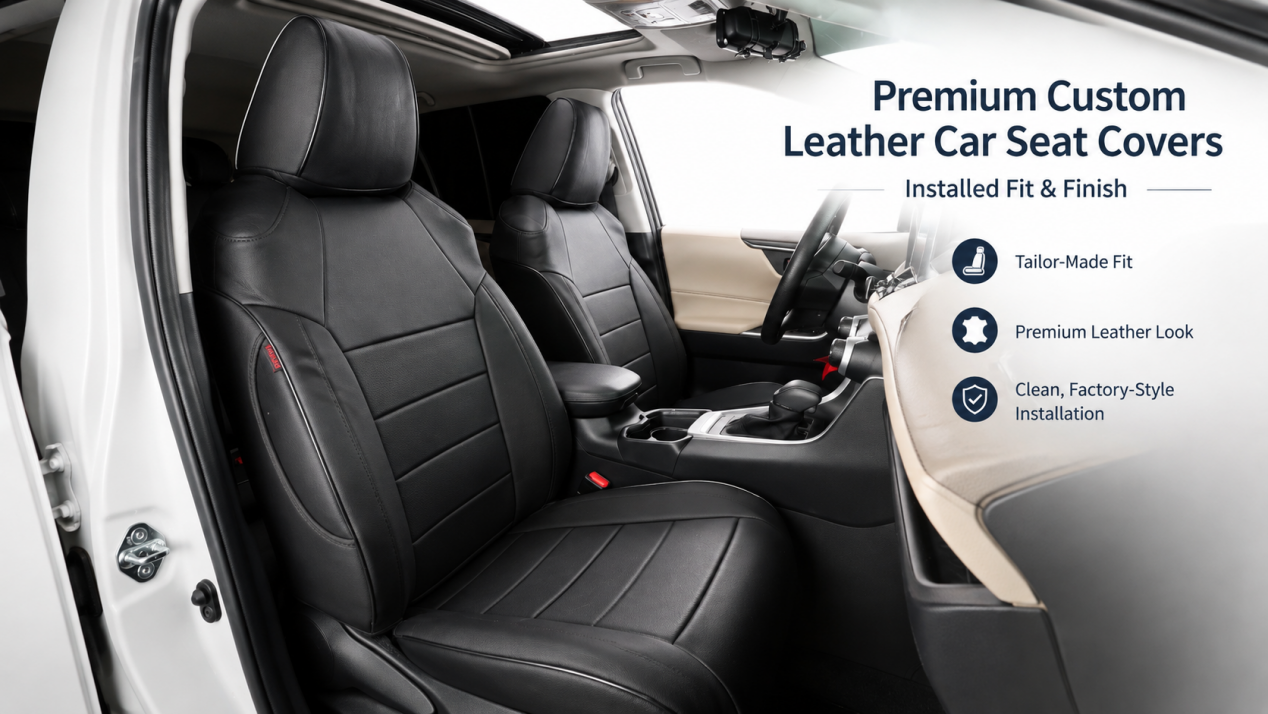
How to Choose the Right Seat Cover Material
The best material is not always the most expensive one.
It should match your target customer, price level, vehicle use, climate, cleaning requirements, and overall product positioning.
A rental fleet may care more about maintenance than decorative stitching. A premium customization shop may care much more about texture, softness, quilting, perforation, and edge finishing.
PU Leather
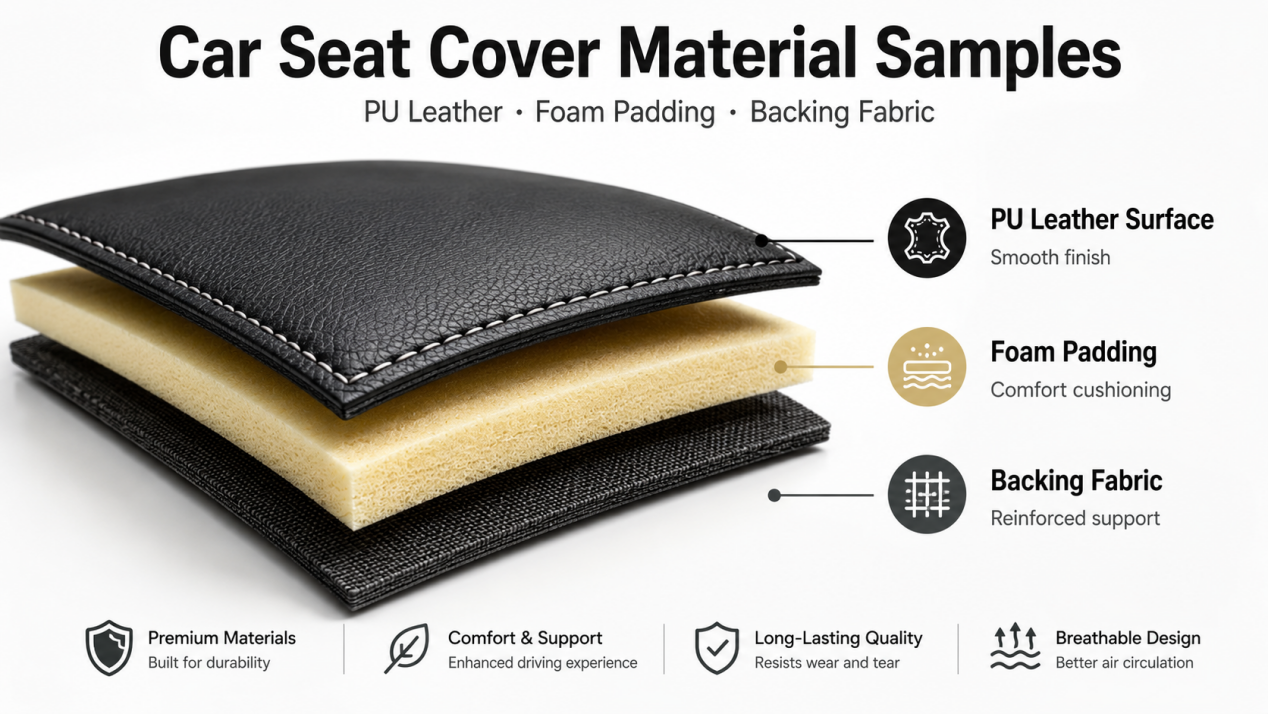
PU leather is widely used for automotive seat covers because it can provide a leather-like appearance at a more accessible cost.
It is available in many colors, grain patterns, textures, finishes, and thicknesses.
It can also be combined with:
- Perforated center panels
- Contrast stitching
- Piping
- Quilting
- Foam backing
The main challenge is that PU quality varies significantly.
Low-grade material may feel thin, stiff, excessively glossy, or plastic-like. Under heavy use, weak constructions can also show surface wear earlier.
For wholesale purchasing, do not approve material from digital images alone.
Request physical swatches and finished-product samples.
Premium Leather and Leather-Like Materials
Higher-value seat covers require more than a thicker surface material.
Customers in premium segments often notice grain consistency, softness, surface feel, color depth, foam structure, perforation quality, stitching definition, and the way the material follows seat contours.
Premium material also demands better sewing capability.
An attractive material can still look inexpensive if the quilting is uneven, piping twists around corners, or seams do not follow the intended pattern.
For this reason, evaluate material quality and manufacturing craftsmanship together.
Polyester, Fabric, and Neoprene-Style Materials
Fabric-based products may be better for buyers focused on breathability, flexibility, sport styling, outdoor use, or lower price points.
Polyester can work well in entry-level products, work vehicles, or promotional programs.
Neoprene-style materials may appeal to customers looking for sportier styling or additional protection from moisture and daily use.
However, confirm the actual material construction.
The term "neoprene" can be used broadly, while laminated materials may differ substantially in foam thickness, backing, flexibility, odor, and durability.
What to Check in a Material Sample
Avoid specifications that only say "premium leather."
Ask the supplier to document:
- Material type
- Supplier material code
- Color code
- Surface grain
- Thickness
- Backing structure
- Foam specification
- Perforation
- Thread specification
- Approved physical reference
Also inspect odor, surface consistency, flexibility, stitch behavior, and fold recovery.
A flat material swatch shows you how the raw material looks.
A finished seat-cover sample shows you whether that material actually works with the pattern, foam, sewing process, and installation method.
What Quality Specifications Should Wholesale Buyers Check?
An attractive sample is not enough.
B2B buyers need standards that can be reproduced during mass production.
The most important areas are pattern accuracy, stitching, fastening, material consistency, and packaging accuracy.
Pattern Accuracy and Coverage
Install the product on the intended vehicle whenever possible.
Inspect the seatback, cushion, bolsters, corners, headrest area, control openings, and rear-seat sections.
Look for:
- Excess material
- Large wrinkles
- Exposed original upholstery
- Excessive tension
- Poor corner coverage
- Seams that do not follow the seat
- Incorrect functional openings
Rear-seat folding and split functions should still work where applicable.
Stitching and Seam Quality
Inspect long visible seams first.
Stitch spacing should be consistent, and there should be no obvious skipped stitches, loose threads, open seams, or unstable tension.
If the product uses quilting, compare matching panels.
Diamond patterns, horizontal channels, or other decorative stitching should remain balanced from left to right.
Stress areas also require attention because installation puts additional tension on corners, openings, and fastening points.
Anchoring and Installation Stability
Hooks, straps, buckles, elastic sections, and other fastening components should be easy to understand and reach during installation.
After fitting the product, sit in the seat and move normally.
The cushion should not immediately slide forward, and side edges should not pull out of position.
For installation shops, fastening design also affects labor cost.
A product that requires constant adjustment can reduce the profit margin on each installation.
Batch-to-Batch Consistency
Your second order should not feel like a different product from your first.
Control:
- Material color
- Grain and gloss
- Foam thickness
- Pattern version
- Thread
- Stitching
- Fastening components
- Labels
- Packaging
Use a written specification together with an approved physical sample.
If the manufacturer needs to replace a material or component, approval should be obtained before the change reaches mass production.
What Should North American Buyers Consider About Safety and Compliance?
North American compliance should be treated as a defined product-development task rather than a generic certificate request.
Requirements can depend on product design, destination, installation method, material construction, and customer or retailer requirements.
For aftermarket seat covers in the U.S., NHTSA interpretation materials are particularly useful because they distinguish aftermarket seat covers from original vehicle certification requirements and discuss potential interference with safety systems.
Side-Airbag and Seat Function Considerations
Many modern vehicles use seat-mounted side airbags.
If the seat cover occupies an area related to deployment, ask the manufacturer how the pattern and construction have been designed for the intended vehicle.
Do not stop at the phrase "airbag compatible."
Ask:
- What exactly was tested?
- Which seat or vehicle was used?
- Which laboratory conducted the test?
- What construction was evaluated?
- Is mass production using that same construction?
NHTSA has specifically addressed aftermarket covers and side-airbag concerns, including the risk of equipment being installed in a way that interferes with required vehicle safety systems.
The same principle applies to seat controls, buckles, headrests, rear-seat folding, heating, and ventilation.
Material and Flammability Documentation
When a customer or import program requires flammability-related documentation, review the actual report.
In the United States, FMVSS 302 flammability requirements address burn resistance for specified materials used in vehicle occupant compartments.
At the same time, NHTSA interpretation materials are important when determining how those original-vehicle requirements relate to aftermarket slip-on seat covers.
For Canadian programs, buyers can also review Transport Canada's flammability requirements for vehicle interior materials.
Do not check only the name of the test standard.
Review what was actually tested.
A finished seat cover may contain:
- Surface material
- Foam
- Backing
- Adhesive
- Thread
- Piping
- Other laminated components
Changing one of these elements can make an older report less representative of the current production construction.
Labels, Packaging, and Market Requirements
Review product labels, warnings, installation instructions, traceability information, retailer requirements, and packaging before artwork is printed.
If the product is sold in California, Proposition 65 requirements may require review depending on relevant chemicals and exposure conditions. OEHHA provides the official business guidance and warning framework.
The practical rule is:
Define the requirement first, and then ask the supplier for documentation that directly supports that requirement.
Avoid treating "North American compliance" as one generic checkbox.
OEM, ODM, and Private Label Options
Customization can help wholesalers and retailers build a more defensible product line.
Depending on the factory, customization may include materials, colors, stitching, branding, packaging, and vehicle-specific pattern development.
Every additional option also adds production complexity.
Choose customization that gives customers a clear reason to choose your product or accept a higher price.
Custom Colors, Materials, and Stitching
Color, quilting, perforation, piping, and contrast thread can substantially change the product's position.
If several materials are used in one cover, compare their tone and gloss under the same lighting.
For repeat production, approve physical swatches and retain the exact material codes.
Decorative stitching should also be standardized.
Premium quilting loses value quickly if left- and right-side patterns are visibly different.
Logo and Brand Customization
Branding options may include:
- Embroidery
- Woven labels
- Printed labels
- Packaging
- Manuals
- Inserts
- Retail cartons
Embroidery requires careful positioning because unsuitable placement or tension can distort the surrounding material.
Provide the manufacturer with clear artwork, dimensions, colors, and positioning requirements before sample approval.
Custom Packaging
Retail packaging needs strong product identification and compatibility information.
E-commerce packaging needs compact dimensions, parcel protection, and a logical unpacking experience.
Dropshipping buyers should also confirm whether neutral or private-label packaging is available.
Vehicle-Specific Pattern Development
For premium seat covers, pattern development can be one of the most valuable forms of customization.
A proper process generally includes:
Vehicle data → Pattern creation → Sample sewing → Real installation → Fitment review → Pattern correction → Final approval
Ask how the manufacturer records revisions.
If a supplier cannot identify which pattern version applies to a particular year, trim, or seat configuration, managing a large catalog can become difficult.
How to Evaluate a Wholesale Seat Cover Manufacturer
A supplier needs to do more than make one attractive sample.
It needs to reproduce that product consistently.
When comparing manufacturers, look beyond price, catalog size, and marketing statements.
For vehicle-specific products, the strongest partners generally combine pattern development, material handling, skilled sewing, quality control, and disciplined repeat-order management.
Vehicle Pattern Development Capability
Ask how the factory develops new applications.
Does it work with physical vehicles, direct measurements, digital templates, an existing pattern database, or a combination?
More importantly, ask how it validates the final fit.
A pattern that looks correct on a cutting table can still fail around a bolster, headrest, rear-seat split, or control opening.
For new applications, pattern revision is normal.
What matters is whether the factory has a repeatable process for testing, correcting, approving, and storing the final version.
Material Handling and Sewing Expertise
Premium leather-style materials require controlled cutting and sewing.
Inspect:
- Long seams
- Tight curves
- Quilting
- Piping
- Perforation
- Reinforced areas
- Material transitions
A factory experienced primarily with inexpensive universal textile products may not automatically have the same capability with thicker or more demanding premium materials.
Match the manufacturer's real production expertise to the product you intend to sell.
Quality Control System
Ask the manufacturer to explain its QC system in practical terms.
A useful system normally includes:
Incoming material inspection → First-piece approval → Inline inspection → Finished-product inspection → Packaging verification
Do not treat "100% inspection" as a complete answer.
Ask what inspectors check, how specifications are controlled, and how defects are classified.
North American Market Experience
Experience with North American customers can reduce communication gaps around vehicle applications, retail packaging, documentation, SKU systems, and product expectations.
However, not all export experience is equivalent.
A factory mainly supplying inexpensive universal products may not have the same pattern-development and material-handling capability as one specializing in premium vehicle-specific programs.
EKR, for example, focuses on vehicle-specific seat cover programs, North American applications, precise installation fit, and higher-grade leather-style material processing. These are the kinds of supplier capabilities B2B buyers should verify when building a product line above the lowest-price segment.
Communication and After-Sales Support
A good supplier should make complex projects easier to manage.
Evaluate quotation accuracy, sample feedback, pattern revisions, defect handling, replacement support, and record keeping.
If you report a fitment issue, a capable partner should ask for evidence such as installation photos, vehicle information, measurements, or video.
You need root-cause analysis, not simply "no problem."
Production Capacity and Lead Time
A perfect sample does not prove a supplier can handle larger volumes.
Ask about:
- Normal capacity
- Peak-season scheduling
- Material procurement time
- Sample-development time
- Production lead time
- Reorder lead time
A smaller specialist factory may still be the better partner if it produces your type of product more consistently.
Supplier Evaluation Scorecard
|
Evaluation Factor |
What to Check |
Recommended Weight |
|
Vehicle Pattern Capability |
Pattern database, new-model development, real-vehicle testing, revision control |
20% |
|
Fitment Accuracy |
Wrinkle control, seam alignment, coverage, functional openings |
15% |
|
Material Quality |
Surface consistency, thickness, backing, foam, durability, color stability |
10% |
|
Sewing & Craftsmanship |
Stitch consistency, quilting alignment, piping, reinforced areas |
10% |
|
Quality Control |
Incoming inspection, first-piece approval, inline QC, final inspection |
10% |
|
North American Experience |
Vehicle applications, packaging, documentation, customer requirements |
10% |
|
Customization Capability |
Materials, colors, stitching, branding, private label |
5% |
|
MOQ Flexibility |
Model, color, material and mixed-SKU requirements |
5% |
|
Lead-Time Reliability |
Samples, bulk production, peak-season capacity |
5% |
|
Communication |
Quotation accuracy, revision speed, technical support |
5% |
|
After-Sales Support |
Replacements, defect handling, corrective action |
5% |
|
Total |
|
100% |
Buyer’s Tip: For premium vehicle-specific covers, pattern capability, fitment accuracy, and repeat production should usually carry more weight than a small difference in factory price.
Use a Trial Order
A trial order gives you more useful information than a sales presentation.
Choose a manageable quantity and several applications that reflect the complexity of your future program.
Evaluate:
- Sample development
- Communication
- Bulk consistency
- Packaging
- Delivery
- Fitment
- After-sales response
Then compare production units directly with the approved sample.
MOQ, Wholesale Pricing, and Total Landed Cost
Unit price should never be evaluated alone.
The real cost of sourcing includes the product, packaging, freight, duties, inspection, inventory, defects, returns, and customer-support burden.
A slightly higher factory price can still produce a better margin if downstream costs are lower.
What Determines Wholesale Pricing?
Seat cover pricing is usually influenced by:
- Material grade
- Number of components
- Vehicle complexity
- Quilting and stitching
- Foam and backing
- Custom colors
- Branding
- Packaging
- Order volume
- New-pattern development
A full three-row SUV set, for example, normally involves substantially more components and production work than a simple front-seat application.
Compare factories using the same specification.
Otherwise, the lowest quotation may simply represent a different product.
How MOQ Changes With Customization
One wholesale program may contain several different MOQs.
The seat-cover factory may accept a relatively low quantity while the material supplier or packaging printer requires a larger batch.
Ask whether MOQ applies per:
- Vehicle application
- Material
- Color
- Design
- Packaging version
- Overall purchase order
This becomes especially important when planning mixed-SKU orders.
Calculate Total Landed Cost
A practical landed-cost calculation can include:
|
Cost Category |
What It Includes |
Why It Matters |
|
Factory Unit Cost |
Material, sewing, accessories |
Starting point, not final cost |
|
Customization |
Branding, colors, stitching, packaging |
May add setup costs and MOQ |
|
Freight |
Inland transport and international shipping |
Packaging volume can materially affect cost |
|
Import Cost |
Duties, customs clearance, brokerage, insurance |
Must be included before setting margins |
|
Inspection |
Factory or third-party QC |
Helps reduce bulk-order risk |
|
Warehouse |
Receiving, storage, labeling, preparation |
More important with many vehicle SKUs |
|
Returns |
Freight, inspection, repacking |
Fitment errors can make returns expensive |
|
Replacement |
Replacement components and reshipping |
Logistics may cost more than the part |
|
Customer Support |
Fitment and installation questions |
Poor installation experience increases workload |
|
Installer Labor |
Additional adjustment time |
Important for customization shops |
|
Slow-Moving Stock |
Capital tied up in low-demand SKUs |
Reduces cash-flow efficiency |
Companies importing directly into the United States should also review the U.S. import process and customs requirements when estimating landed cost. CBP's current guidance emphasizes the shared responsibility of importers and the agency for compliance with import laws and regulations.
Why Better Fit Can Reduce Hidden Costs
Consider this illustrative example:
|
Cost Category |
What It Includes |
Why It Matters |
|
Factory Unit Cost |
Material, sewing, accessories |
Starting point, not final cost |
|
Customization |
Branding, colors, stitching, packaging |
May add setup costs and MOQ |
|
Freight |
Inland transport and international shipping |
Packaging volume can materially affect cost |
|
Import Cost |
Duties, customs clearance, brokerage, insurance |
Must be included before setting margins |
|
Inspection |
Factory or third-party QC |
Helps reduce bulk-order risk |
|
Warehouse |
Receiving, storage, labeling, preparation |
More important with many vehicle SKUs |
|
Returns |
Freight, inspection, repacking |
Fitment errors can make returns expensive |
|
Replacement |
Replacement components and reshipping |
Logistics may cost more than the part |
|
Customer Support |
Fitment and installation questions |
Poor installation experience increases workload |
|
Installer Labor |
Additional adjustment time |
Important for customization shops |
|
Slow-Moving Stock |
Capital tied up in low-demand SKUs |
Reduces cash-flow efficiency |
Illustrative example only; actual costs depend on your business.
Supplier A appears $5 cheaper at factory level.
Once returns, support, and additional installation work are considered, Supplier B may produce the lower effective cost.
That is why fitment quality belongs in the financial comparison.
Watch the Cost of Too Many SKUs
Vehicle-specific products can tie up cash if too many low-demand applications are stocked.
Track sales at SKU level.
Keep deeper inventory for fast-moving applications and smaller quantities for niche models.
Where possible, smaller reorders, scheduled production, or dropshipping can provide broader application coverage without requiring equal stock for every vehicle.
Why You Should Order Samples Before Bulk Production
A sample helps identify problems while they are still inexpensive to correct.
Use it to evaluate material, workmanship, installation, packaging, and commercial viability before committing to mass production.
For a new supplier, new vehicle pattern, new material, or customized product, skipping this stage creates unnecessary risk.
Check Material and Craftsmanship
Inspect:
- Color
- Grain
- Thickness
- Backing
- Foam
- Stitching
- Quilting
- Piping
- Fastening components
Compare matching panels side by side.
You are checking both quality and repeatability.
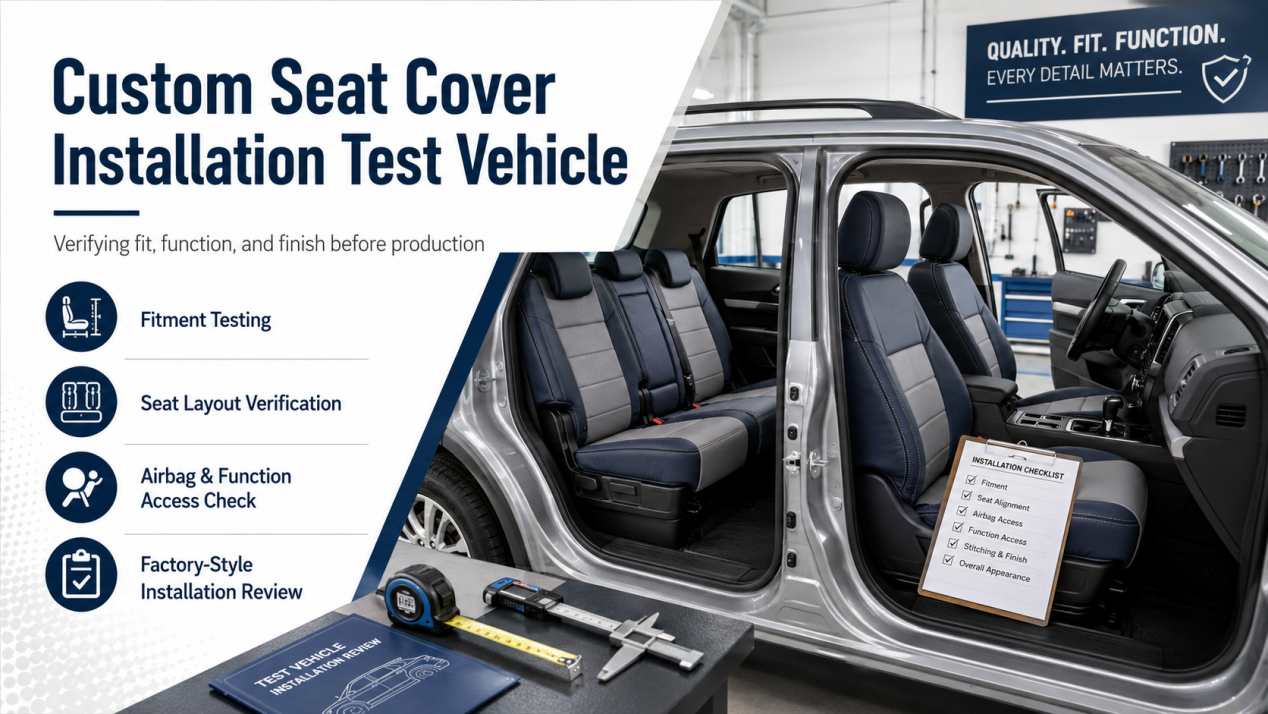
Perform a Real Vehicle Installation
Install the sample on the correct vehicle application.
Confirm the make, model, year, trim, and seat configuration.
During installation, check:
- Installation time
- Wrinkles
- Coverage
- Seam position
- Strap positioning
- Corner tension
- Headrest fit
- Control access
- Rear-seat operation
After installation, sit in the seat and move normally.
The cover should remain stable.
Test From the Customer's Perspective
A factory may consider a product acceptable because it can technically be installed.
Your customer may have a different standard.
If the product is marketed as premium custom fit, evaluate the sample at the retail price you intend to charge.
Ask:
Would the final installation look good enough to justify that price?
Approve a Golden Sample
Once the sample meets your requirements, keep an approved physical reference.
Document:
- SKU
- Vehicle application
- Pattern version
- Material
- Color
- Foam
- Stitching
- Fasteners
- Logo
- Packaging
The supplier should retain the same reference for production.
Document Every Revision
Give specific feedback.
Instead of:
"Fit is loose."
Use:
"Reduce excess material around the outer driver-side backrest bolster."
Specific photographs, measurements, and version numbers make corrections much easier to execute.
How Quality Control Works for Bulk Orders
Mass production introduces additional operators, materials, batches, and opportunities for variation.
Quality control should therefore begin before sewing and continue through final packing.
Do not rely on final inspection alone.
Incoming Material Inspection
Compare production materials with the approved specification.
Check color, thickness, grain, backing, foam, and visible defects.
If a material needs to be substituted, request approval before cutting starts.
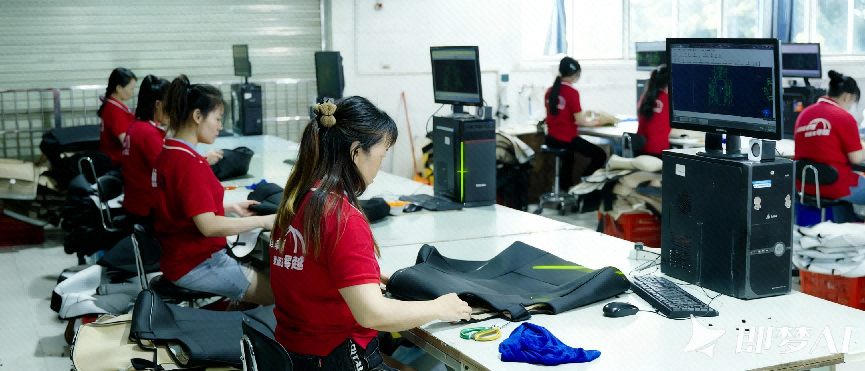
Cutting and Sewing Inspection
Use the approved pattern version.
For factories producing many vehicle-specific SKUs, cut components also need clear identification so that similar seat pieces are not mixed.
During sewing, inspect seam alignment, stitch quality, quilting, piping, and high-stress areas.
First-Piece Approval
Before the full order runs, inspect an early unit made with actual bulk materials.
Compare it with the golden sample.
Confirm:
- Pattern
- Material
- Color
- Thread
- Stitching
- Accessories
- Logo
- Labels
- Packaging
This step can catch an error before it reaches hundreds of units.
Inline Inspection
Inline QC identifies recurring problems while production is still running.
If one sewing station begins producing inconsistent seams, the issue can be corrected before the full batch is completed.
Fitment and Functional Checks
For new patterns and high-risk SKUs, include installation checks on production samples.
Verify seat contours, fastening locations, controls, buckles, rear-seat movement, and relevant functions.
New, complex, premium, and high-volume applications normally deserve more attention than mature low-risk SKUs.
Use AQL-Based Sampling Where Appropriate
For larger orders, buyers can use an AQL-based random sampling inspection to define sample sizes and acceptance criteria.
ASQ describes ANSI/ASQ Z1.4 and Z1.9 as sampling standards that provide plans, procedures, and acceptance levels for inspection.
The inspection plan should match the value, complexity, and risk of the order.
Final Product and Packaging Inspection
Before shipment, verify that each set is complete.
Check:
- Product components
- Accessories
- Vehicle SKU
- Barcode
- Labels
- Instructions
- Quantity
- Master-carton markings
A correctly manufactured seat cover with the wrong vehicle label is still a failed order.
Packaging, Shipping, and Inventory Planning
Packaging and inventory decisions affect freight cost, fulfillment accuracy, and cash flow.
This becomes especially important when you manage many vehicle-specific SKUs.
Retail Packaging vs. Bulk Packaging
Retail packaging helps sell the product.
It may include:
- Product images
- Vehicle compatibility
- Brand information
- Barcodes
- Material information
- Installation instructions
Bulk packaging can be simpler if the product goes directly to installers or downstream distributors.
Do not pay for retail presentation if your sales channel does not need it.
E-Commerce and Dropshipping Packaging
Parcel packaging should be compact, protective, and easy to identify.
Avoid oversized cartons, but do not compress the product so aggressively that materials or quilting arrive badly creased.
Pack small accessories separately.
Make installation instructions easy to locate.
For dropshipping programs, confirm neutral or private-label packaging and accurate vehicle-specific fulfillment.
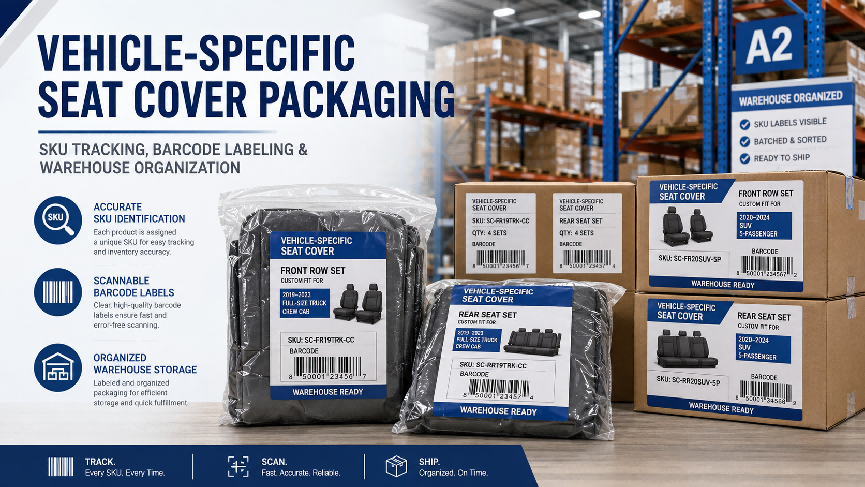
Manage Vehicle-Specific SKUs Carefully
A useful internal SKU structure may include:
- Vehicle
- Model year range
- Seat configuration
- Material
- Color
- Pattern version
Marketing titles can remain simple.
Internal compatibility data should be precise.
For retail and multi-channel distribution, standardized GTIN and barcode identification can help maintain consistent product identification across suppliers, warehouses, retailers, and marketplaces. GS1 defines GTIN as an identifier for trade items that may be priced, ordered, or invoiced in a supply chain.
Plan Inventory Around Demand
Do not stock every application equally.
Classify products as:
Fast-moving → Medium-moving → Slow-moving
Keep deeper inventory for your most popular applications.
Use smaller reorders for low-demand models.
This reduces dead stock without unnecessarily limiting your catalog.
Plan Reorders With the Full Lead Time
Do not calculate reorder timing from sewing time alone.
Include:
Material preparation + Production + Inspection + Export handling + International freight + Customs + Warehouse receiving
If a SKU sells 100 sets each month and the full replenishment cycle takes two months, your reorder point must cover expected demand during that period plus appropriate safety stock.
Optimize Packaging Volume
Seat covers are not especially heavy, but they can consume substantial shipping volume.
Ask for packed dimensions, unit weight, master-carton dimensions, and carton quantities before confirming the freight plan.
Better carton utilization may lower freight costs.
Avoid excessive compression that damages product presentation.
Keep Replacement Parts
For important SKUs, consider maintaining spare:
- Headrest covers
- Cushion panels
- Backrest sections
- Armrest components
- Hooks
- Straps
Replacing one component is usually more efficient than replacing an entire seat-cover set.
Step-by-Step Process for Buying Wholesale Seat Covers
A disciplined sourcing process is easier to scale than an informal one.
Step 1: Define Your Market and Product Position
Identify:
- Target customer
- Sales channel
- Price segment
- Priority vehicle applications
- Required material level
- Fitment expectations
Decide whether universal, semi-custom, or vehicle-specific products best match that strategy.
Step 2: Shortlist Suitable Manufacturers
Evaluate manufacturers based on the product you actually want to sell.
For premium custom-fit covers, prioritize:
- Vehicle pattern development
- Real-vehicle validation
- Premium material handling
- Sewing capability
- Quality control
- North American experience
Step 3: Send a Clear RFQ
Give each shortlisted supplier the same specification.
Include:
- Vehicle application
- Product construction
- Materials
- Color
- Quantity
- Branding
- Packaging
- Destination
- Testing or documentation requirements
Ask for quantity breakpoints rather than a single price.
Step 4: Order and Test Samples
Inspect the physical product and install it on the intended vehicle.
Do not approve vehicle-specific products from digital photographs alone.
Step 5: Lock the Production Specification
Confirm:
- Pattern version
- Material code
- Color
- Foam
- Stitching
- Thread
- Accessories
- Branding
- Packaging
- Labels
- Instructions
Use a golden sample.
Step 6: Inspect Production and Shipment
Use first-piece approval, inline inspection, and final verification.
For new patterns, add fitment testing.
Before shipment, confirm product quantities, carton data, documentation, and vehicle-specific SKU accuracy.
Step 7: Review Sales and Returns
After launch, track:
- Sales velocity
- Return rate
- Fitment complaints
- Installation questions
- Product defects
- Missing parts
- Replacement requests
Analyze these metrics by SKU.
Then use the information to improve the next order.
Common Mistakes When Buying Seat Covers Wholesale
Many expensive sourcing problems are predictable.
Most begin before production.
Choosing by Price Alone
A cheaper quotation may use thinner material, simpler construction, less foam, weaker fasteners, or less precise patterns.
Compare the same specification before choosing a supplier.
Assuming One Pattern Fits Every Version
Model names are not enough.
Model year, trim, rear-seat configuration, headrest design, and controls can change the pattern.
Maintain accurate compatibility records.
Skipping Sample Installation
Professional photos can hide poor fitment.
Install the product before approving mass production.
Ignoring Batch Consistency
A good first sample does not guarantee a consistent reorder.
Control materials, pattern versions, threads, accessories, and packaging over time.
Using Weak SKU Identification
Many seat covers look similar once folded.
One incorrect label can send a correctly manufactured product to the wrong customer.
Use structured SKU identification and barcodes.
Launching Too Many Vehicle Applications at Once
Broad coverage can tie up cash in slow-moving stock.
Start with higher-demand applications and expand using actual sales data.
Treating "Custom Fit" as Proof
Ask how the fit was developed and tested.
The phrase itself does not prove pattern accuracy.
Neglecting Installation Instructions
A product can fit correctly and still be returned because the customer cannot install it.
Test the installation instructions with the same product customers will receive.
Ignoring Replacement Support
Ask whether the factory can supply individual panels and accessories.
This can significantly reduce after-sales costs.
Which Seat Covers Fit Your Business Model?
The right product depends on how your business creates value.
Wholesalers and Distributors
Focus on:
- Stable specifications
- Vehicle coverage
- Mixed-SKU flexibility
- Repeat supply
- Inventory control
- Reliable reorders
For premium channels, repeatable fitment may be more important than achieving the lowest possible factory price.
Auto Customization Shops
Prioritize:
- Precise fit
- Premium material feel
- Predictable installation
- Clean finishing
- Design choices
Customers are paying for the completed interior result, not simply seat protection.
Retailers and E-Commerce Sellers
Prioritize:
- Compatibility data
- Product presentation
- Packaging
- Installation support
- Low return rates
Show the installed result on real vehicles whenever possible.
Rental Companies and Fleets
Focus on:
- Durability
- Cleaning
- Stable installation
- Replacement support
- Lifecycle cost
A slightly more expensive product can still deliver better value if it lasts longer and requires less maintenance.
Dropshipping Sellers
Prioritize:
- SKU accuracy
- Product data
- Neutral/private-label packaging
- Shipping visibility
- Fast replacement support
In this model, the supplier becomes part of your end-customer experience.
Private-Label Automotive Brands
Control materials, colors, patterns, packaging, and repeat production carefully.
Customers see your brand—not the factory behind it.
Why Premium Custom-Fit Seat Covers Can Be a Better Wholesale Strategy
Premium custom-fit products allow B2B sellers to compete on more than price.
They give customers a visible reason to choose one product over another and provide more opportunities to build a differentiated brand.
Compete on Fit and Quality
Universal covers are easy to compare because many sellers offer similar products.
Vehicle-specific products require pattern development, vehicle validation, and more detailed production management.
That can make direct price comparison less important.
Improve the Installation Experience
A well-developed pattern reduces unnecessary adjustment.
For professional installers, that can save labor.
For e-commerce customers, it can reduce frustration and installation-related support requests.
Build Higher Perceived Value
Customers can see:
- Cleaner fit
- Better materials
- Controlled stitching
- Better edge coverage
- Vehicle-specific detailing
These features can support higher retail positioning when the target market values them.
Strengthen Private-Label Positioning
A private-label product is more defensible when it is not easily interchangeable with generic alternatives.
Fitment, materials, design, packaging, and support can all become part of the brand experience.
Use Premium Features Selectively
Premium does not mean adding every possible feature.
Choose details that improve:
- Appearance
- Fitment
- Durability
- Usability
- Brand recognition
Complexity customers cannot see or value only makes production harder.
Build the Strategy Around Repeatability
One impressive sample is not enough.
The commercial value comes from producing the same fit, color, material, and workmanship repeatedly.
For B2B buyers targeting mid-range and premium automotive markets, that consistency can make custom-fit seat covers a more sustainable strategy than competing indefinitely on the lowest unit price.
Frequently Asked Questions About Wholesale Seat Covers
What Is the Difference Between Universal and Custom-Fit Seat Covers?
Universal covers use a general pattern intended for many vehicles.
Custom-fit covers are developed for specific vehicle applications.
Universal products simplify inventory, while custom-fit products generally provide more accurate appearance and stronger premium positioning.
What Information Does a Factory Need for Custom-Fit Covers?
Provide the make, model, year, relevant trim information, body style, seat configuration, rear-seat split, headrests, armrests, controls, and clear photographs.
Also provide commercial requirements such as material, color, quantity, branding, packaging, and target market.
Can Wholesale Seat Covers Be Private Labeled?
Yes.
Common options include:
- Packaging
- Woven or printed labels
- Embroidery
- Instructions
- Barcodes
- Retail cartons
- Colors
- Materials
- Stitching
How Should I Test a Sample?
Inspect the material and workmanship first.
Then install the product on the exact intended vehicle and check fit, wrinkles, seam positions, controls, rear-seat functions, fastening, and installation time.
What Should I Ask a Supplier Before Ordering?
Ask about:
- Pattern development
- Real-vehicle testing
- Materials
- MOQ
- Customization
- QC
- Packaging
- Lead time
- Replacement support
- Documentation
- Repeat-order consistency
Specific answers are more useful than generic claims about "high quality."
What MOQ Should I Expect?
There is no universal MOQ.
It may vary by vehicle, material, color, packaging, branding, and pattern development.
Ask for each requirement separately.
Should I Choose the Lowest-Priced Supplier?
Not automatically.
Compare total landed cost, fitment, return risk, installation time, material consistency, quality control, and after-sales support.
Can I Mix Vehicle Models in One Order?
Many manufacturers support mixed-SKU orders.
Material, color, or packaging MOQs may still apply, so confirm how the supplier calculates minimum quantities.
How Can I Reduce Returns?
Use accurate vehicle data, validate patterns on real vehicles, provide clear installation instructions, verify packaging labels, and track return causes by SKU.
How Important Is the Factory's Pattern Database?
Very important for custom-fit products.
However, accuracy matters more than the number of patterns.
Ask how applications are tested, revised, identified, and linked to specific vehicle configurations.
Can I Order Replacement Parts Instead of Complete Sets?
This depends on the manufacturer.
For premium B2B programs, individual replacement panels and accessories can substantially reduce after-sales costs.
Conclusion
Successful wholesale seat cover sourcing requires more than comparing quotations.
The strongest programs balance precise fitment, suitable materials, consistent manufacturing, accurate vehicle data, disciplined quality control, manageable inventory, and total landed cost.
Universal products may be appropriate for price-driven markets. Vehicle-specific custom-fit products can make more sense when distributors, retailers, and installation shops want stronger differentiation and higher-value positioning.
Before scaling an order, test the product on a real vehicle, approve a golden sample, document every production specification, and confirm that the manufacturer can reproduce the same standard across repeat orders.
For buyers focused on premium vehicle-specific seat covers for the North American market, a manufacturing partner such as EKR can support programs that require precise fitment, experienced handling of higher-grade leather-style materials, private-label customization, and repeatable B2B supply.
The goal is not simply to find a supplier that can make a seat cover.
It is to build a sourcing system that can deliver the right product, for the right vehicle, at the right quality level—again and again.


